
Lumber & Materials
Inside the Mill: How a Log Becomes Framing Lumber
Follow framing lumber through the sawmill, kiln, planer, and grading line. Learn what the process, KD and HT marks, and grade stamps mean for your home.
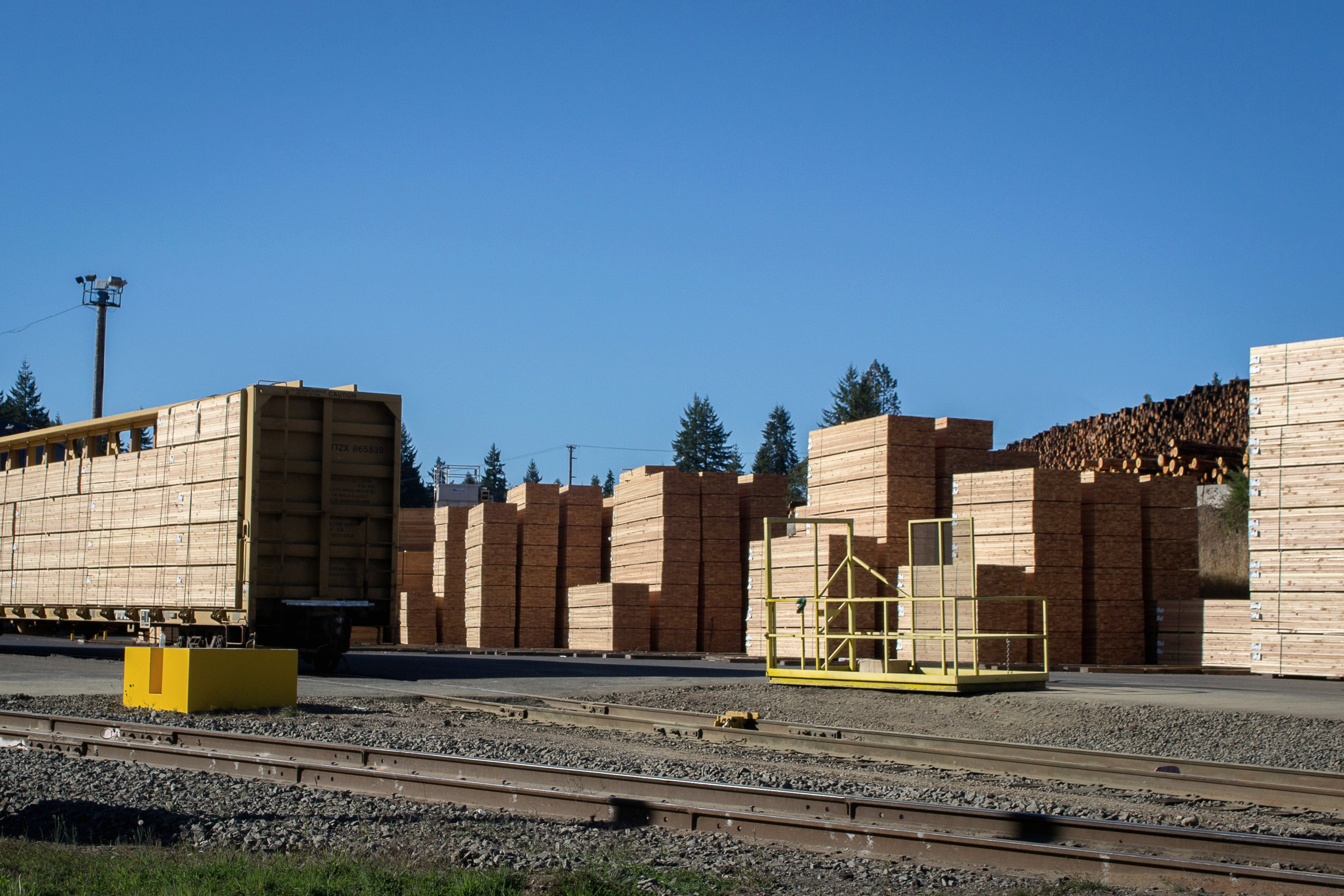
A framing board looks simple because a lot of complicated work happened before it reached the jobsite. A mill has taken a round, variable log and produced a useful building material with a size, grade, and identity the construction team can check.
That transformation explains several questions customers ask: Why is a two-by-four smaller than its name? Why do boards have knots? What does kiln-dried mean? And what is all that ink on the side?
Here is the broad path for solid-sawn framing lumber. Mills differ in equipment, species, products, and processing sequence. This describes common operations, not a claim about the origin of every board in a Timberline project.
1. Receive and sort the logs
At the mill, incoming logs are received and evaluated for the products the operation makes. Size, shape, species, and quality influence what can be recovered. A log suitable for one product is not automatically the best raw material for another.
The logyard also provides an inventory between deliveries and production. The lumber supply chain has more moving parts than a truck arriving at a house, which is one reason exact product availability should be checked before approving a substitution.
For a customer, the useful connection is straightforward: lumber specifications start with the material the building needs, not whichever bundle happens to arrive first.
2. Remove bark and saw the wood into useful pieces
Debarking removes the outer bark before the principal sawing operations. Logs may be cut to processing lengths, then broken down into lumber or intermediate shapes that pass through additional saws and edgers.
Modern operations may use scanners and optimization systems to choose cuts that recover useful sizes from each log. Trimming and sorting organize the resulting pieces for the next stages. A round log cannot become identical rectangles without decisions about where every cut goes.
The other material has destinations too. Depending on the operation and markets, bark, chips, sawdust, and shavings can become coproducts or fuel. That does not justify a blanket “zero waste” claim. If sourcing or environmental certification matters to your project, ask for the specific documentation rather than assuming every mill operates identically.
3. Dry the lumber for its intended product category
Freshly sawn wood contains moisture. Many framing products are kiln-dried, using controlled conditions to remove water. Other lumber is sold green or follows a different drying route. A kiln is a controlled manufacturing step, not simply an enormous oven with a timer and somebody hoping for the best.
Drying matters because wood changes dimensions as its moisture condition changes. The USDA Forest Products Laboratory emphasizes that drying, handling, and storage work together; drying at the mill does not prevent later wetting or movement.
For common dimension lumber, KD identifies kiln-dried material and S-DRY identifies surfaced-dry material. PS 20-25 defines dry lumber under nominal five-inch thickness using a maximum moisture content of 19 percent. That is a product classification, not a universal permission to cover jobsite framing at that reading.
HT means heat treated. It does not mean pressure-preservative treated for decay exposure. Drying, heat treatment, and preservative treatment answer different questions.
4. Surface the pieces to their finished form
Planing removes material to produce smoother surfaces and the intended finished dimensions. In a common dry-lumber production route, drying precedes final planing; other products and mill sequences differ.
This is part of the reason a nominal size is not the same as the dimension you measure. The familiar trade name identifies a size category. Standard dressed sizes account for the manufactured product rather than promising that a finished two-by-four measures exactly two inches by four inches.
When matching existing framing in a remodel, the crew should measure what is actually there. A nominal label is useful for ordering, but it cannot settle an old-to-new alignment by itself.
5. Grade, identify, and package the lumber
Grading sorts lumber according to recognized rules. Visual grading considers relevant characteristics; machine grading combines machine evaluation with required visual checks. Knots do not automatically make a board unusable, and an attractive face does not establish the structural grade required by the plans.
A typical grade mark communicates five kinds of information: the supervising grading agency, producing mill, grade, species or species group, and seasoning condition. Layouts and abbreviations vary. These marks let the supplier and construction team compare the delivered product with the specification.
The grade applies to the material when graded. Later damage, poor storage, or inappropriate alteration is a separate concern. Packaging and transport do not end the need to protect and check it.
What should a Minnesota customer ask?
Ask which species, grade, size, and moisture designation the plans require; who verifies deliveries; and how substitutions are approved. If you want a particular sourcing certification, discuss availability and documentation before ordering.
Then ask how the lumber will be stored and protected through Minnesota weather. The mill has done a substantial amount of work before the bundle reaches your property. Good jobsite handling preserves that work, and correct installation turns the right material into the right part of your home.
Sources behind this guide
- NIST: American Softwood Lumber Standard, PS 20-25, January 2025.
- USDA Forest Products Laboratory: Wood Handbook—Wood as an Engineering Material, FPL-GTR-282, 2021; Chapters 6, 7, and 13.
- CORRIM: Life Cycle Assessment for the Production of Inland Northwest Softwood Lumber, March 2020 report version; manufacturing process descriptions.
- Rayonier: How Trees Become Lumber, September 30, 2021; reported tour of a West Fraser sawmill.
- Weyerhaeuser: Lumber, current product information; examples of green and kiln-dried product categories.